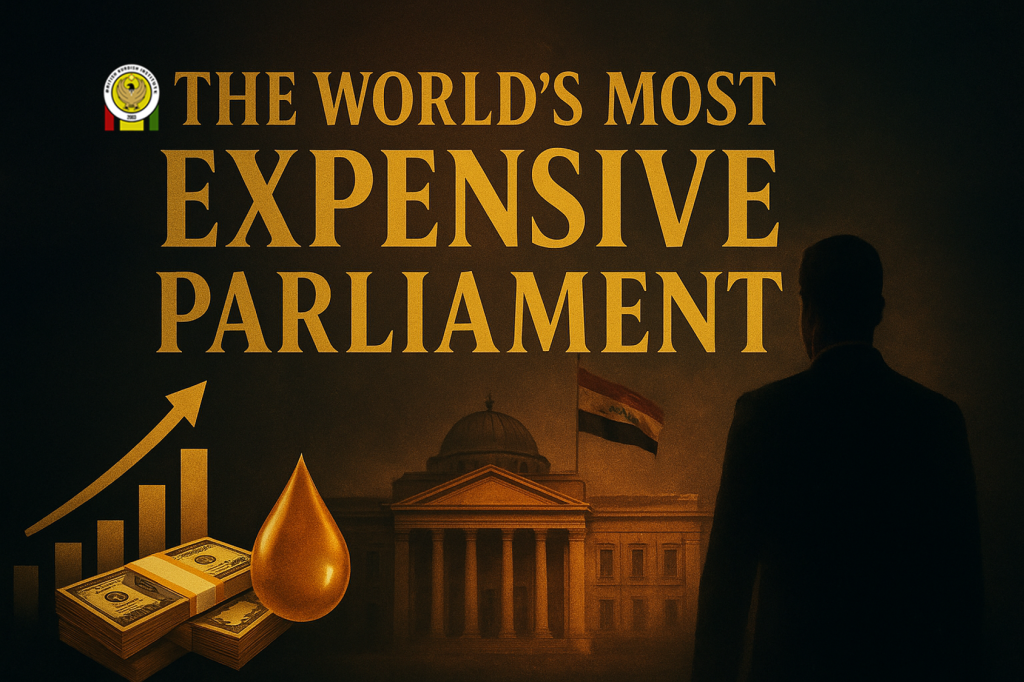
On November 11, 2025, citizens of Iraq and the Kurdistan Region will head to the polls to elect the sixth session of the Iraqi Parliament — an institution that costs nearly half a billion US dollars every year to maintain.
Record-Breaking Election Numbers
According to the Independent High Election Commission (IHEC), 7,768 candidates are competing for 329 parliamentary seats across 18 provinces. Despite major population differences between provinces, Iraq stands out as having the most expensive parliament in the world — far surpassing other federal or parliamentary states.
Rising Political Costs
IHEC data shows that the number of political parties and coalitions continues to grow every year, with more candidates registering for each election cycle. Similarly, the Ministry of Finance reports that parliamentary expenditures have risen by an average of 3.1% annually over the past decade.
Between 2015 and 2024, the total cost jumped 30%, from 470 billion dinars to 612 billion dinars. Most of this increase comes from operating costs — especially salaries.
Salaries Driving the Surge
Salary expenses alone have increased by 18%, bringing total wage expenditures for parliamentary employees and affiliated institutions from 469 billion to 607 billion dinars per year. This surge highlights a broader pattern: a government body whose financial growth outpaces national productivity.
The Most Expensive MPs in the World
A comparative study by the Inter-Parliamentary Union (IPU) and the Welsh Parliament (UK) reveals that Iraqi MPs are the world’s most expensive legislators. Each earns around 216 million dinars annually — roughly three times more than lawmakers in Sweden, Ireland, France, New Zealand, and Finland, and twice as much as those in the United States, the United Kingdom, and Germany.
This distribution of oil wealth has made the Iraqi Parliament not only the most costly in the region but also more expensive than the parliaments of the world’s oldest democracies.

A Controversial System
Official figures may not tell the full story. One Iraqi MP recently admitted that he pays half of his 9-million-dinar monthly salary to his political party — a sign of the financial entanglements that blur the line between politics and patronage.
Even the number of personal guards varies by member: while each MP once had 40 guards, the current number averages 16, depending on seniority and influence.
Democracy on Paper, Corruption in Practice
Despite these enormous expenses, Iraq remains far from free, according to Freedom House’s Index of Freedom and Democracy. The report notes that while elections are organized and competitive, corruption, militia influence, and weak institutions continue to cripple democratic governance.
State officials and armed groups frequently violate citizens’ rights through both legal loopholes and illegal means.
Gender and Demographics: Unequal Representation
When measured by demographics, Iraq’s candidate ratio suggests that one in every 80 families has a member running for office. However, gender inequality remains stark: men make up 69.8% of candidates, while women represent only 30.2%, often competing merely to secure the final “quota” seat in each constituency.

A Billion-Dollar Parliament Without Reform
The staggering $2 billion in expenditures for each parliamentary session — including independent institutions — comes as Iraq still operates under pre-2005 legal frameworks.
Crucially, the country has yet to pass a national oil and gas law, despite the fact that oil revenue accounts for 91% of state income and 85% of GDP growth.