
Inviting the same political actors who enabled Israel’s unchecked expansion—until Gaza finally exploded—and expecting them to deliver peace is not just delusional. It is criminal.
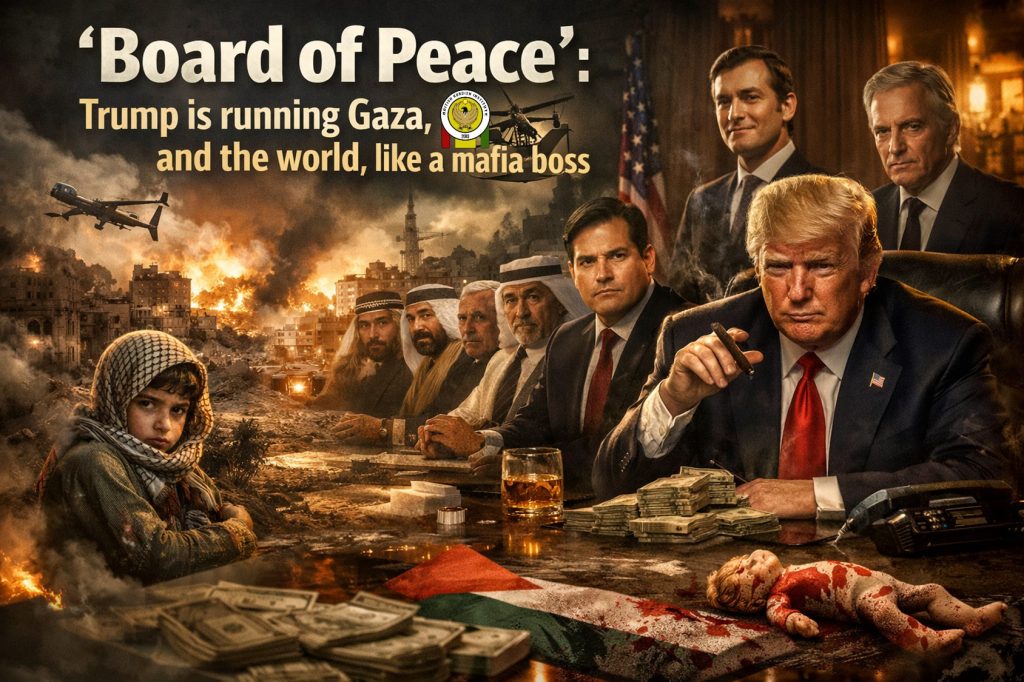
Donald Trump’s so-called “Board of Peace” has attracted a long guest list. Saudi Arabia, Turkey, Egypt, Morocco, and several other regional powers have taken seats at the table. Yet one group is conspicuously hesitant: Western governments.
This reluctance has little to do with Gaza itself. Europe’s hesitation stems from deep mistrust of Trump’s broader geopolitical ambitions, particularly his positions on Greenland and Ukraine. With a reported entry price of $1 billion and widespread concern that the initiative is designed to sideline the United Nations, skepticism is hardly surprising.
A Board Built on Denial
At the heart of the Board of Peace sits an executive committee dominated by figures who have publicly denied that a genocide is taking place in Gaza. Among them are US Secretary of State Marco Rubio, Trump’s special envoy Steve Witkoff, Jared Kushner, and Wall Street financier Mark Rowan—known for pressuring US universities to suppress pro-Palestinian protests.
What unites them is not diplomacy or expertise, but a striking lack of knowledge about the Middle East.
The only figure with hands-on regional experience is former British Prime Minister Tony Blair—if one considers the invasion of Iraq and the ignition of a seven-year civil war as “experience.”
Tony Blair: Present, But Representing No One
Despite Blair’s prominent role, the British government has gone out of its way to distance itself from him. Senior officials privately confirmed that Blair does not represent the UK state in any capacity.
Jonathan Powell, now Britain’s national security adviser and Blair’s former chief of staff, actively lobbied against Blair’s involvement. Within Whitehall, Blair is widely viewed as a political relic—eager to reclaim relevance on the international stage, but disconnected from current realities.
Even Prime Minister Keir Starmer has carefully avoided endorsing Blair as Britain’s representative, offering only vague praise while refusing formal support.
The Illusion of Governance in Gaza
According to the Board’s charter, executive members will wield real authority over Gaza’s future. A secondary body—the confusingly named Gaza Executive Board—includes representatives from Turkey, Qatar, and Egypt. While these figures possess genuine regional knowledge, their inclusion appears largely symbolic.
A White House statement claims the board will deliver “effective governance” and “best-in-class services” for Gaza. In reality, these phrases are so vague they could mean anything—or nothing at all.
Turkey, Qatar, and Saudi Arabia have not signed on out of submission. Their participation reflects a strategic attempt to maintain influence, particularly amid fears of permanent Israeli occupation and ethnic cleansing.
Advisors with Blood on Their Hands
Further tilting the balance in Israel’s favor are advisors with deeply troubling records. Among them is Aryeh Lightstone, a staunch supporter of Israeli settlements and a key figure behind the Gaza Humanitarian Foundation—where more than 2,000 Palestinians were killed while seeking aid.
Another appointment, Bulgarian diplomat Nikolai Mladenov as Gaza’s “high representative,” raises questions about whether Gaza is being reshaped into a technocratic protectorate rather than a self-governing territory.
At the lowest level sits a so-called technocratic government, largely rejected by Palestinian factions. Its security chief, Sami Nasman, lives in exile after being sentenced in absentia by a Gaza court for inciting violence and orchestrating assassination attempts.
Ceasefire in Name Only
Witkoff announced the second phase of the ceasefire by placing the entire burden on Hamas, demanding full demilitarization under threat of “serious consequences.” Not one word was said about Israel’s obligations.
Israel continues to occupy over 60 percent of Gaza, has violated the ceasefire more than 1,000 times, and has killed hundreds of Palestinians since the agreement was signed.
Tony Blair, meanwhile, declared Trump’s 20-point plan an “extraordinary achievement,” insisting the war had ended—a claim that will surprise anyone living under daily airstrikes, floods, freezing winters, and starvation in Gaza.
A Mafia Model of Global Power
Trump does not pretend to care about Palestinians, justice, or human rights. His interest lies elsewhere: carving out geopolitical fiefdoms and extracting financial loyalty.
By assembling his own circle of loyal enforcers and branding them a “Board of Peace,” Trump is attempting to run global politics the same way he runs America—not as a statesman, but as a mafia boss demanding tribute and obedience.
History suggests Palestinians will not comply. They have endured colonization, exile, siege, and genocide—yet their national identity remains unbroken.
This so-called Board of Peace will be discarded long before Trump himself fades from the stage of history.