Syria’s post-Assad leadership is repeating historical mistakes, argues Dr. Mohammed Ihsan, confusing regime change with a license to exclude. Without inclusive governance that respects Syria’s diverse population, the transitional authority risks perpetuating authoritarianism under a new name.
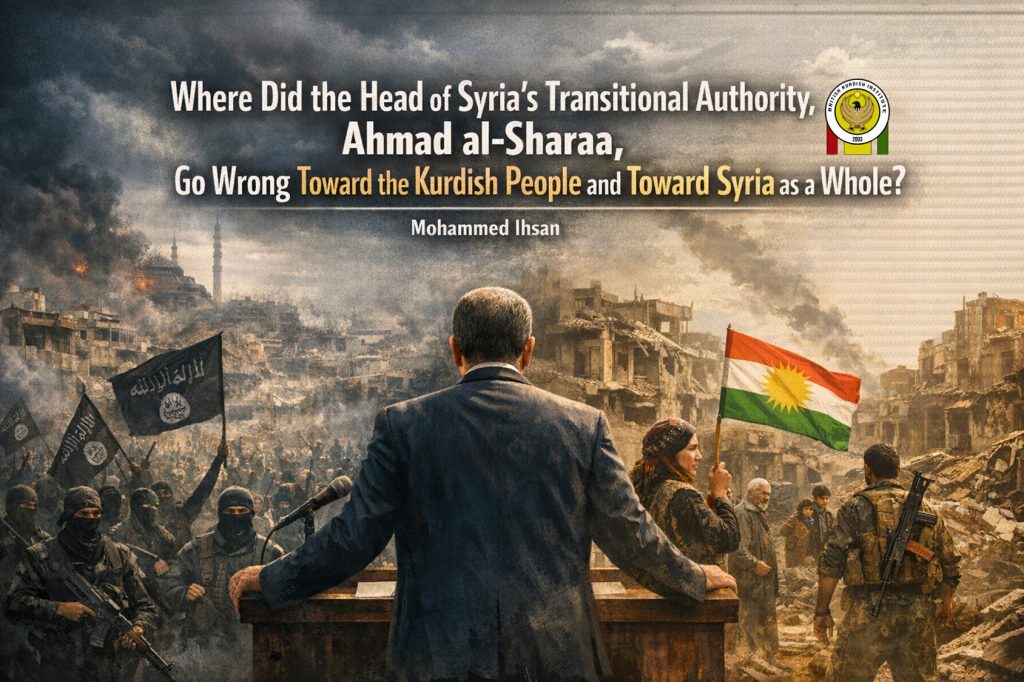
Ahmad al-Sharaa, head of Syria’s transitional authority, has made a series of serious political and moral errors in his handling of the country’s diverse communities. These mistakes are not limited to the Kurdish population—they have affected almost every segment of Syrian society. At the heart of the problem lies a fundamental misconception: treating the fall of Assad as a victory over the Syrian people, rather than a victory over the regime itself.
For over five decades, Syria was ruled by the Assad family and a narrow elite spanning multiple sects. Entire communities did not govern the country, nor can they be held collectively responsible for the regime’s crimes. Yet, the transitional authority increasingly uses rhetoric implying collective guilt, justifying exclusion and punishment based on community rather than individual actions.
This approach reflects a dangerous intoxication with power, blurring the line between dismantling authoritarian rule and reproducing it in a new form. Defeating a dictatorship does not give anyone the right to dominate society, suppress dissent, or marginalize alternative voices. History across the region shows that such behavior only breeds renewed authoritarianism and conflict.
Concentration of power within a narrow circle linked to Hay’at Tahrir al-Sham has only deepened these concerns. Political participation has been restricted, alternative voices sidelined, and the perception has emerged that one exclusionary system is being replaced by another rather than dismantled altogether.
Syria’s pluralism is not theoretical—it is a lived reality shaped by multiple ethnicities, religions, and sects. Any political project ignoring this diversity risks tearing the country apart from within. Calls for Syrians to engage politically as abstract individuals, stripped of their Kurdish, Druze, or Alawite identities, are often seen as dismissive of historical injustices and legitimate grievances.
The Kurdish issue exemplifies this failure. Kurds, Syria’s second-largest ethnic group and predominantly Sunni Muslim, have been excluded rather than engaged as equal partners. Policies of marginalization have turned potential allies into adversaries, weakening national cohesion and inadvertently empowering rival actors.
A more constructive approach was available. Without undermining Syria’s sovereignty or Arab cultural identity, the transitional leadership could have taken steps such as:
-
Constitutional recognition of Syria as a multi-ethnic, multi-religious state
-
Guarantees for mother-tongue education alongside Arabic
-
Recognition of Nowruz as a national holiday
-
Equal access for all communities to political, cultural, and media institutions
Such measures could have built trust rather than resentment.
Concerns over sovereignty and legitimacy remain significant. Instead of grounding authority in domestic consensus, the transitional leadership relies heavily on regional and international backing. While foreign support is unavoidable, legitimacy dependent on external actors is fragile and can compromise national independence.
Security policies have further eroded trust. The inclusion of foreign fighters with extremist backgrounds into military structures undermines the credibility of national forces. Reports of civilian abuses in coastal regions and Suwayda, coupled with a lack of accountability, have reinforced communal fears of sectarian governance.
It is equally critical to reject the narrative that Sunni Arabs are inherently sectarian. Many oppose collective punishment and advocate for a civic state based on equal citizenship. Policies stigmatizing them alongside other groups only deepen polarization.
Syria stands at a crucial crossroads. The fall of the Assad regime offered a rare opportunity to establish a state based on citizenship, justice, and equality. That opportunity remains fragile. Replacing one authoritarian system with another, even under revolutionary rhetoric, will not stabilize the country or heal its divisions.
For genuine legitimacy, Syria’s transitional authority must abandon domination, embrace inclusivity, and recognize the diversity of its people. Accountability for abuses and political partnership with all communities are not concessions—they are the foundation of any viable Syrian state. Without such a shift, Syria risks repeating its past under a new set of rulers.