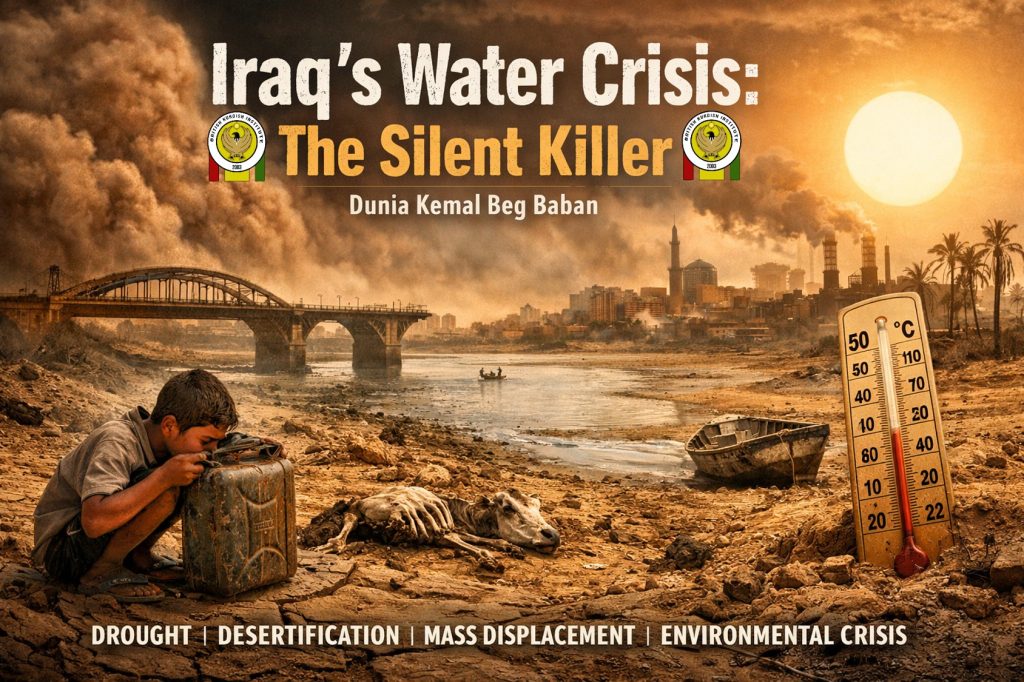

Iraq is facing one of the most severe water crises in the world—an escalating emergency driven by climate change, regional geopolitics, and decades of policy failure. Once defined by the lifeblood of the Tigris and Euphrates rivers, the country now stands on the brink of chronic freshwater collapse, with profound consequences for public health, agriculture, and national security.
Iraq: Among the World’s Most Climate-Vulnerable Countries
According to the UN GEO-6 report, Iraq ranks as the 5th most climate-vulnerable country globally, a classification reaffirmed by UNEP, FAO, and the World Bank. UNICEF’s 2021 Iraq report warned that worsening water scarcity is already stunting children’s development and undermining access to safe drinking water.
Climate data shows Iraq has been warming seven times faster than the global average since the 1970s. IPCC AR6 projections forecast temperature increases of 2–4°C by 2050, and up to 7°C by the end of the century under high-emission scenarios. In southern Iraq, summer temperatures now regularly exceed 50–54°C, pushing human habitability to dangerous limits.
Collapse of the Tigris and Euphrates River System
The country’s water backbone is rapidly deteriorating. The 2020–2021 rainfall season, the second-driest in 40 years, caused a 29% drop in Tigris flows and a catastrophic 73% decline in the Euphrates. Iraq’s total water reserves fell from 18 to just 10 billion cubic meters, their lowest level in over 80 years.
FAO data (2023) confirms that Tigris–Euphrates flows have declined 30–40% since the 1980s, placing drinking water supplies, agriculture, and ecosystems at severe risk. Iraq’s projected Water Stress Index of 4.6 out of 5 by 2040 signals near-total freshwater scarcity.
Desertification, Dust Storms, and Agricultural Collapse
Desertification now affects 92% of Iraqi territory, with 39% severely degraded and another 54% at moderate risk. Once-productive farmland is turning into barren land marked by cracked soil and advancing sand.
Agricultural output has collapsed as a result. Wheat and barley production has fallen 30–40% during recent drought years, devastating rural livelihoods. Dust storms—once seasonal—have surged from around 120 days per year in the early 2000s to over 270 days today, disrupting daily life and triggering public health crises, including spikes in asthma, COPD, and hospital admissions.
Water Scarcity, Displacement, and Social Instability
Water shortages are now driving internal displacement. The Iraqi Parliament’s Agriculture Committee (2025) reports that rural water collapse is forcing farmers and villagers into overcrowded cities, overwhelming infrastructure and heightening social tensions.
The International Organization for Migration (IOM) estimates over 20,000 people are displaced annually due to drought and water scarcity. Meanwhile, industrial and municipal pollution further degrades river quality, compounding public health risks.
Regional Politics and Failed Water Governance
Iraq’s water crisis is not only environmental—it is deeply political. Decades of short-term negotiations with Türkiye have failed to produce binding, long-term water guarantees. The proposed 2019 Türkiye–Iraq Action Plan stalled amid conflict, weak coordination, and unresolved disputes.
In April 2024, Iraq and Türkiye signed a 10-year Strategic Framework Agreement, followed by a financing mechanism in November 2025. This controversial “oil-for-water” arrangement channels Iraqi oil revenues to Turkish companies for water infrastructure projects. Critics argue the deal prioritizes foreign investment over transparent quotas and guaranteed water flows to Iraq.
Iran has further intensified the crisis by rapidly expanding dam construction along the shared border—from 316 dams in 2012 to 647 by 2018—without binding bilateral agreements. Iran’s own prolonged drought and mismanagement now force it to retain water, drastically reducing downstream flows into Iraq.
Water Crisis as a National Security Threat
The decline of the Tigris and Euphrates is eroding ecosystems, livelihoods, and state legitimacy. Iraq’s water crisis has become a direct threat to governance and national security, fueling displacement, economic collapse, and social unrest.
Urgent reforms are required. Domestically, Iraq must establish a national water diplomacy body, rehabilitate infrastructure transparently to curb corruption, and modernize irrigation systems to reduce waste. Regionally, Iraq should leverage its 2023 accession to the UNECE Water Convention, engaging international mediators such as the UN to secure binding water agreements with Türkiye and Iran.
The Cost of Inaction
The cost of inaction will be measured in lost water, collapsing agriculture, eroded public trust, and weakened national stability. Iraq’s future depends on whether governance—not geography—determines its water security.