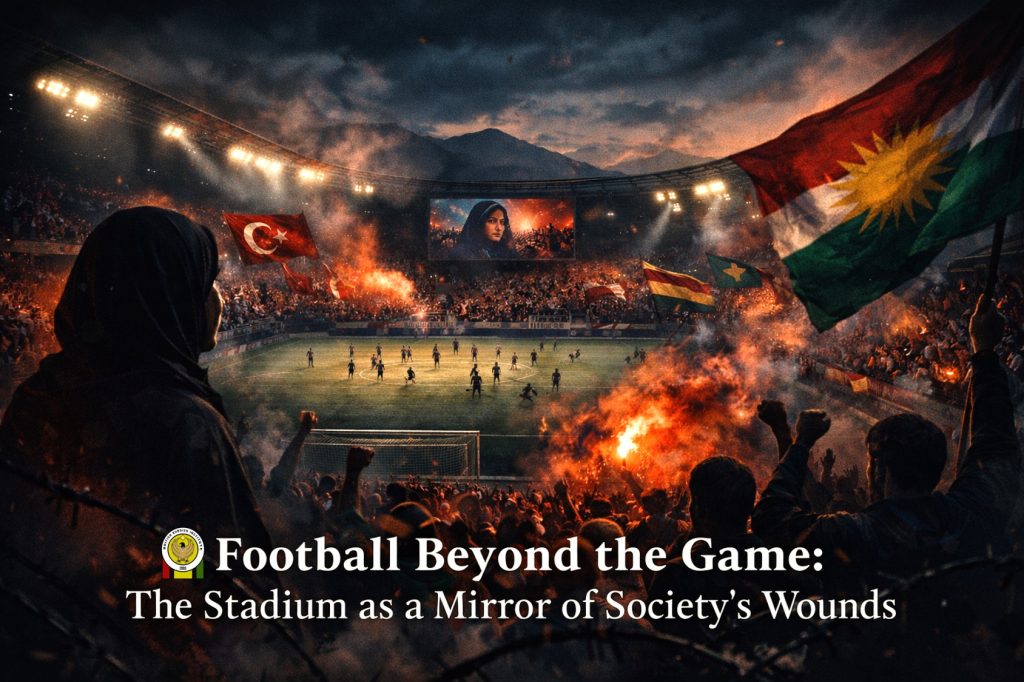

A stadium is never just concrete, seats, and grass. It is a space of concentration where everything that finds no room in everyday life gathers. Emotions are not explained there; they are released. This is why football is never merely a game. It functions as a social resonance chamber in which memories, frustrations, fears, and unresolved conflicts surface all at once. When people enter the stands, they do not come only with club colors. They bring their personal and collective histories with them, and in the chants and shouts of the terraces, the hidden layers of society become visible.
Affect Instead of Argument
The insults directed at Leyla Zana in a stadium in Bursa cannot be understood as political analysis or rational positioning. They were pure affect: loud, raw, and collective. That is precisely why they matter. Stadiums are places where individuals are rarely the real target. What is addressed is always a group, an identity, a symbolic “other” onto which accumulated tensions are projected.
From Individual to Collective Target
In reality, the hostility was not aimed at Leyla Zana as a person. She functioned as a projection surface. The anger was directed at Kurds as a whole, at their visibility, their history, and their presence in public space. Her name allowed a long-suppressed conflict to discharge itself without being articulated. What could not be said openly found expression through noise.
The Logic of the Crowd
Stadiums operate through simplification. Complexity disturbs them. Ambivalence is perceived as weakness. The crowd demands clarity: friend or enemy, victory or defeat, us or them. In such a logic, there is no room for figures who remember, mediate, or question. They disrupt the emotional flow, and whatever disrupts is booed.
How Aggression Is Learned
Fan aggression is rarely spontaneous. It is learned over time. Media play a decisive role in this process, not through direct incitement but through constant repetition of simplified narratives. Headlines that moralize conflict, images that reproduce fear, and debates where volume replaces reflection all prepare the ground. The stadium becomes the final station of a long chain of unreflected discourse. What circulates during the day in commentaries, social media, and political speeches erupts from the stands in the evening. Hatred rarely grows from information; it grows from repetition.
What the Stadium Silences
Most revealing is what is not said in the stadium. There is no history, no responsibility, no discussion of solutions. Affect serves avoidance. It blocks a difficult truth: that the Kurdish question is not primarily a security issue but a social one, and that it is politically solvable. Its persistence has more to do with denial than with terrorism. Noise protects against this confrontation and replaces it.
Collective Emotion and Political Consequences
In affect, responsibility dissolves. The individual disappears into the collective, and shouting replaces thinking. Football fans are therefore not perpetrators in a classical sense. They carry moods produced elsewhere and act emotionally rather than strategically. Yet emotions have political consequences. When entire stands shout in unison, a climate emerges in which dialogue becomes impossible.
When Sport Becomes a Stage
This dynamic becomes especially visible when Kurdish teams play in western Turkey. Matches involving Amed Sport are a clear example. What meets on the pitch is not only two teams, but two expectations. For some, it is simply football. For others, it is a stage for unresolved conflict. At this point, it becomes evident whether sport connects or divides.
The Risk of Turning Football into a Tribunal
A stadium must not become a tribunal. It must not be a place where identity is negotiated or political conflicts are replayed because they failed elsewhere. When Amed Sport plays, it should be about passes, movement, tactics, performance, and joy. Football lives from recognition and respect for the opponent. When these principles collapse, the game loses its integrative power and becomes an extension of social division.
Violence, Memory, and Relocation
Years of research on violence, trauma, and peace processes point to one recurring insight: peace is not only a political condition, but a social learning process. It does not begin with agreements, but with the ability to trust again. Societies shaped by decades of violence carry that violence into language, gestures, and collective emotions. When weapons fall silent, violence does not disappear; it relocates.
The Kurdish Question as a Psychological Conflict
Seen this way, the insults against Leyla Zana were less a political statement than an expression of unresolved history. The Kurdish question is not only political; it is psychological. It touches identity, guilt, fear, and loss of control. Stadium noise functions as a shield against this confrontation. It replaces reflection with volume.
A Different Model Beyond the Border
A look beyond Turkey’s borders shows that another football culture is possible. In Zakho, northern Iraq, a local club’s fans were honored by FIFA for their extraordinary fan culture. They are passionate, loud, and creative, but not hateful. There, people celebrate rather than humiliate. The opponent remains an opponent, not an enemy. Football becomes a space of belonging instead of exclusion.
Aggression Is Not Inevitable
This contrast is instructive. It demonstrates that aggression in stadiums is not a natural law. It is learned, guided, and politically functionalized. Where societies fail to make peace with themselves, football becomes hostile as well. Suppressed conflicts inevitably seek other stages.
Turkey at a Fragile Moment
Turkey stands at a critical historical moment. The peace process is fragile, contradictory, and constantly at risk. It requires more than political agreements; it requires cultural disarmament and a new language of belonging. Hate chants in stadiums are not marginal incidents. They are warning signals that reveal how deep resistance to change still runs.
A Question of Courage
At this point, a different kind of question emerges. Not a legal one, not a tactical or political one, but a question of courage. What if the leadership of Bursaspor apologized to Leyla Zana? Not defensively, not with explanations, but simply for what happened in their stadium and for the space that was surrendered to uncontrolled affect.
A Quiet Gesture Instead of Loud Declarations
And what if they invited her to attend a match? Not as a symbol, not as provocation, not as a political gesture, but as a spectator. Ninety minutes of football. Passes, runs, duels, goals. Nothing more. In a time when loudness is mistaken for strength, such restraint could irritate. And precisely for that reason, it could matter.
Letting the Ball Roll Again
Such a gesture would not defeat or humiliate anyone. But it might open something. A small interruption in the cycle of affect. A moment in which football could again be what it is meant to be: a game, a place of encounter, a space where difference is visible without turning into hatred. Perhaps peace does not begin with grand speeches, but with the courage to stop carrying affect forward and to let the ball roll again.