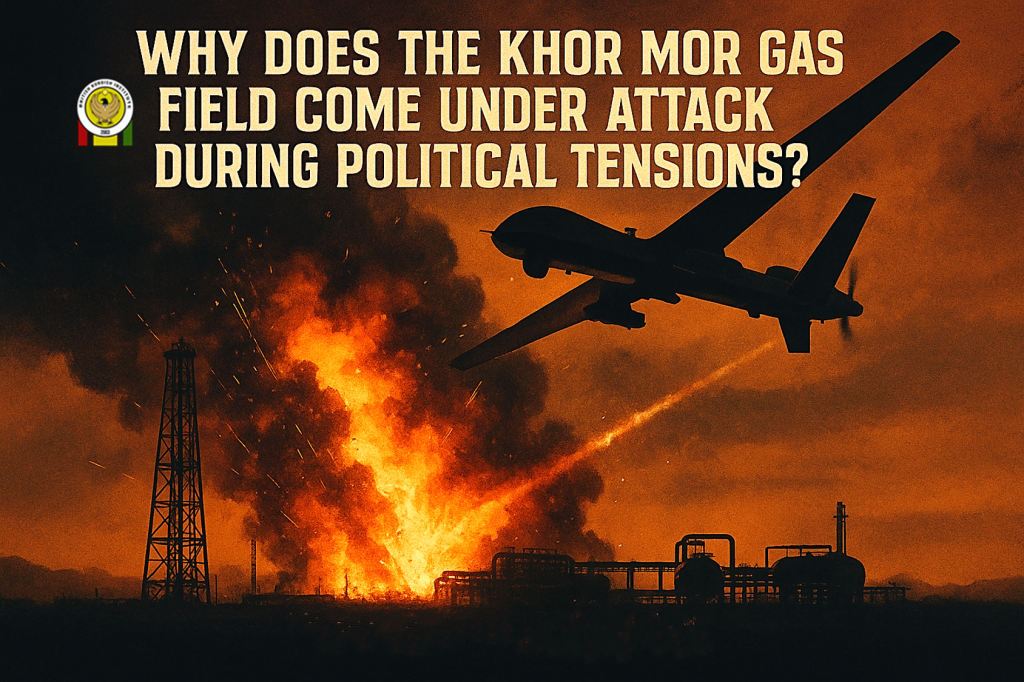

The Khor Mor gas field has faced persistent attacks since the summer of 2022, with nine confirmed strikes carried out by drones or rockets. The latest incident—one of the most damaging so far—plunged parts of the Kurdistan Region into darkness. The pattern of these assaults suggests they are not isolated events or internal disputes. Instead, they reflect a broader strategic agenda that extends beyond local grievances.
Attacks That Align With Political Tensions
A striking feature of these incidents is their timing. Every wave of attacks coincides with heightened political tension, either between Baghdad and Erbil or within the Kurdistan Region itself. Periods of friction between the Kurdistan Democratic Party (KDP) and the Patriotic Union of Kurdistan (PUK) have repeatedly overlapped with strikes on Khor Mor. This pattern indicates deliberate targeting—precisely when political divisions are most pronounced and the region appears most vulnerable.
Strategic Value of the Khor Mor Field
Between 2022 and 2025, Sulaimani province experienced 151 drone and rocket attacks, at least nine of which hit the Khor Mor site. The field’s enormous reserves—an estimated 75 billion cubic meters of condensate gas and seven billion barrels of oil—make it a critical strategic asset. Its location within a 140-kilometer radius further amplifies its importance for the Kurdistan Region’s energy security.
The 2022 Turning Point
Tensions escalated significantly in 2022 after Iraq’s Federal Supreme Court declared the Kurdistan Region’s Oil and Gas Law unconstitutional. As disputes between Baghdad and Erbil intensified, work on the Khor Mor expansion project (KM250) continued—and the site was hit by rockets at least three times that summer.
Political Rivalries and Renewed Attacks in 2023
In 2023, as political parties prepared for regional elections and rivalries deepened, the Khor Mor field was again targeted. Two additional rocket attacks underscored how political fragmentation directly influenced the timing of these assaults.
A Tactical Shift: From Rockets to Drones
Beginning in 2024, attackers shifted from rockets to drones—an adaptation likely driven by improved security measures. Rocket attacks tended to hit peripheral areas, but drone strikes in 2024 and 2025 were far more precise, directly damaging facilities and even gas tankers. These more accurate strikes disrupted daily life, particularly by affecting the Runaki Project, the region’s initiative to provide 24-hour electricity. They also caused power outages in several Iraqi provinces.
Current Political Climate and Renewed Instability
As negotiations for forming new governments in Erbil and Baghdad continue, political tensions are once again high. Disputes between the KDP and PUK and disagreements between Baghdad and Erbil over the federal budget remain unresolved. Amid this turbulence, another drone strike on the Khor Mor field has taken place—once again aligned with a period of political instability.
A Broader Strategic Message
The sustained timing and precision of these attacks suggest they are not merely the actions of local groups acting on short-term interests. Instead, their correlation with periods of political crisis points to a strategic intent: to deepen internal divisions, destabilize governance, and weaken the Kurdistan Region’s energy independence. Beyond the physical damage, the attacks seek to keep the region dependent, vulnerable, and politically fragmented.
Energy Sector Upheaval and the Bigger Picture
These assaults occurred during major upheavals in the Kurdistan Region’s energy sector. The Federal Supreme Court’s ruling against the region’s Oil and Gas Law, the Paris arbitration court’s decision to suspend oil exports until September, and ongoing disputes over the federal budget all contributed to instability. Additionally, U.S. sanctions on Rosneft have further complicated oil pipeline operations. Yet, despite these economic and legal developments, the repeated targeting of the Khor Mor field highlights a deeper strategic goal: disrupting the Kurdistan Region’s path toward energy security.