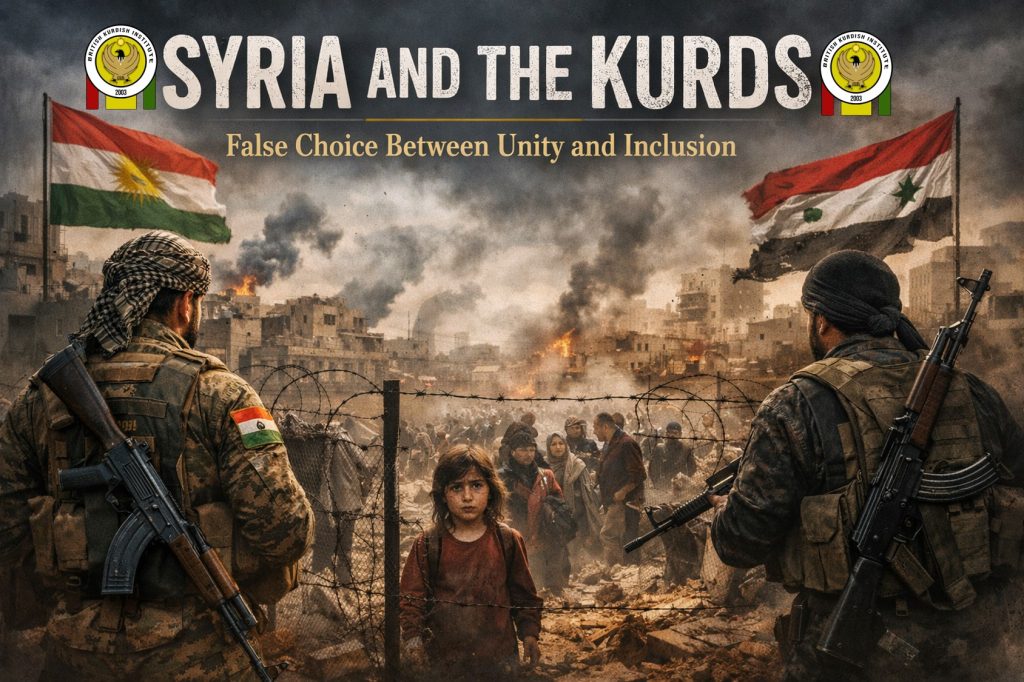

What is unfolding in Syria today is not merely a security crisis. It is a political test of whether the country has truly learned from decades of state collapse. Recent violence in Aleppo’s Kurdish-majority neighborhoods—including mass displacement and videos of armed men humiliating detainees—reflects a centralized, exclusionary mindset rather than isolated incidents.
This conflict is not between Kurds and Arabs. For generations, Kurdish and Arab communities have coexisted, sharing cities, markets, and daily life across northern Syria. The current unrest is a result of political failure, where identity is manipulated to mask the absence of an inclusive state project.
Syria’s interim government assumed power under extraordinary circumstances following the Assad regime’s collapse, enjoying significant domestic support. This transition has created a rare window of cautious optimism. Efforts to restore governance, stabilize fractured regions, and reassert state authority represent a genuine political opening that should not be ignored.
However, this promise depends on whether the interim leadership chooses inclusion over consolidation and agreement over coercion. Coercion cannot resolve the Kurdish question. The Kurdish presence in northern Syria predates the war and will endure beyond any ceasefire. Political solutions must acknowledge this reality to avoid instability.
Fear of decentralization leading to fragmentation or Kurdish independence is misguided. Independence arises not from decentralization but from exclusion, repression, and blocked political channels. History demonstrates that coercion accelerates separation rather than preventing it.
Syria’s problems stem from decades of hyper-centralized rule, exclusion of political participation, and suppression of diversity. Federalism or meaningful decentralization is not a concession—it is the minimum framework capable of holding a plural society together. Without it, Syria risks repeating the conditions that triggered the war.
Using military force, ethnic rhetoric, or dehumanizing language is particularly dangerous. When civilians are referred to as “animals” or denied belonging, it signals political failure, not strength. Words shape politics, and eroding social cohesion will weaken the state.
Regional dynamics complicate the Kurdish question. Developments in Iraq, Türkiye, and Iran influence Syria’s Kurdish population. Exclusion from political negotiations only strengthens regional influences over Syria’s internal affairs. The choice is negotiated coexistence versus enforced instability. A state built on exclusion is unlikely to survive.
Kurds have endured every challenge without bowing to threats—a testament to resilience when politics fails. Syria has a narrow opportunity to prioritize politics over force. How it acts now will determine not only the fate of its Kurds but the viability of the Syrian state itself.