
A Turning Point for Iraq’s Energy Future
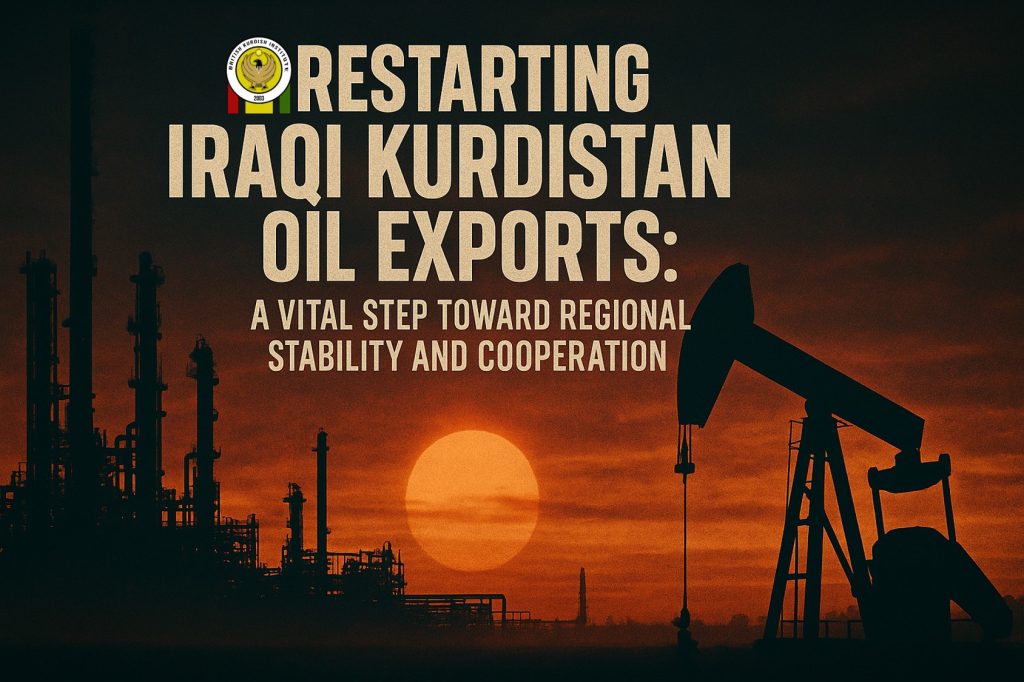
The resumption of oil exports from the Kurdistan Region marks more than the reopening of pipelines — it represents a crucial opportunity to reshape Iraq’s economic and political balance.
After over two years of suspension, oil once again began flowing at 6:00 a.m. last Saturday, following a breakthrough agreement between the Kurdistan Regional Government (KRG), the Iraqi federal government in Baghdad, and major international oil companies.
This development is not merely about economics. It symbolizes a moment of cooperation and shared interest in a region where energy, politics, and sovereignty have long been interlinked.
From Arbitration to Agreement
The halt of Kurdistan’s oil exports dates back to March 2023, when the International Chamber of Commerce (ICC) ordered Turkey to pay Iraq $1.5 billion for facilitating unauthorized oil exports.
The ruling forced the shutdown of the Kirkuk–Ceyhan pipeline, freezing vital exports and costing the KRG billions in lost revenue — a heavy blow to the region’s already fragile economy.
The new deal changes that. Under the agreement, approximately 240,000 barrels per day will be exported. Of these, 180,000 to 190,000 barrels will reach global markets, while around 50,000 barrels will serve local consumption inside the Kurdistan Region. Oversight will be handled by SOMO, Iraq’s state-owned oil marketing company, ensuring closer coordination between Erbil and Baghdad.
Challenges Beneath the Surface
Despite the optimism, not all stakeholders have joined the new framework.
Norwegian oil company DNO ASA, one of the leading producers in the region, has refused to participate, citing unresolved payment and contract issues.
Their continued direct sales to the KRG on a cash-basis system underline the lingering mistrust over revenue-sharing and legal guarantees — reminders that Iraq’s energy disputes are as political as they are financial.
Yet, this partial agreement still matters. It signals that both governments are ready to move beyond deadlock and pursue a sustainable model for energy cooperation.
Economic Stability Through Energy Cooperation
For the Kurdistan Region, resuming exports means more than economic relief — it restores a measure of autonomy and global relevance.
Reconnecting with international energy markets strengthens investor confidence and stabilizes the region’s finances, while Baghdad benefits from a more predictable and unified export structure.
Every barrel of oil flowing through a cooperative framework reinforces the idea that Iraq’s regions can share resources without conflict.
This spirit of collaboration has the potential to evolve into broader political dialogue and reconciliation across the country.
Why This Moment Matters
Oil has always been both a pillar of Kurdish survival and a point of contention with Baghdad.
The transparency, fairness, and stability introduced by this new arrangement can reshape the future of federal-regional relations in Iraq.
If both sides maintain this cooperation, Iraq could move toward a more balanced economic system—one that prioritizes law, equity, and mutual respect over political competition.
Moreover, at a time of volatile global energy markets, a steady and reliable flow of Kurdish oil could enhance regional energy security and attract foreign investment back to Iraq.
Beyond the Valves: Building a Shared Future
Restarting oil exports is not just the act of opening pipelines.
It represents a renewed chance to create a fair, transparent, and mutually beneficial system for resource management — one that acknowledges the rights and responsibilities of all Iraqi stakeholders.
The hope now is that this cooperative mindset will extend beyond the energy sector and inspire broader political, social, and economic partnerships.
If nurtured, this progress could mark the beginning of a new chapter for Iraq’s unity and regional stability.