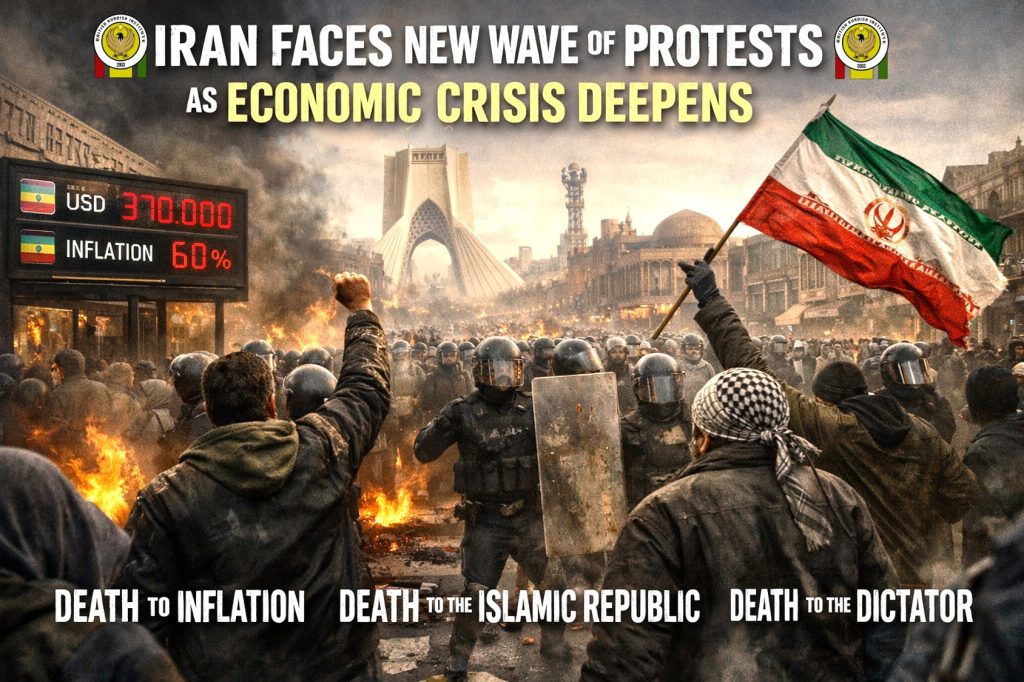
Iran is experiencing a renewed wave of nationwide protests fueled by soaring inflation, the rapid collapse of the rial, and widespread poverty. Unlike the 2022 “Woman, Life, Freedom” uprising—sparked primarily by social repression and rooted in peripheral regions such as Kurdistan and Balochistan—this new unrest began in Tehran, led by shopkeepers from the historic Grand Bazaar.
The involvement of bazaar merchants is particularly significant. Historically, they have played a decisive political role, most notably during the 1979 revolution that overthrew Shah Mohammad Reza Pahlavi. Their participation signals a deep economic rupture at the core of Iran’s urban society.
Inflation, Poverty, and the Collapse of the Middle Class
Despite the resignation of Central Bank Governor Mohammad Reza Farzin, protests have continued for five consecutive days and are rapidly spreading to major cities including Isfahan, Shiraz, and Kermanshah. Universities across the country have also become centers of dissent.
According to figures attributed to Saderat Bank, over 70 percent of Iranians now live below the poverty line. The middle class—once the backbone of social stability—has virtually vanished. In its place stands a sharply polarized society: a vast impoverished majority alongside a tiny, extremely wealthy elite.
Government Response and the Risk of a Crackdown
Iran’s social fabric is unraveling as the economy deteriorates and political institutions lose credibility. In an attempt to contain unrest, authorities declared a public holiday—officially citing cold weather—and replaced the head of the central bank.
For now, the state appears cautious, likely aiming to limit international backlash. However, protest slogans have already evolved from economic demands such as “Death to inflation” to overtly political chants including “Death to the Islamic Republic” and “Death to the dictator.” As the movement radicalizes, a harsher crackdown seems increasingly likely.
Why Repression Has Failed Before
History suggests that repression alone has never succeeded in halting popular mobilization in Iran. Rising casualties have often intensified resistance rather than silencing it. As deaths mount, demonstrators are expected to continue taking to the streets, prolonging an already volatile confrontation between society and the state.
Leadership Vacuum Inside and Outside Iran
Mass protest movements inevitably generate leadership, yet many of Iran’s most influential figures remain imprisoned or silenced. Nobel Peace Prize laureate Narges Mohammadi remains detained in Evin Prison. Cultural figures such as rapper Toomaj Salehi and actress Taraneh Alidoosti, along with labor unions and Kurdish organizations like the Kurdistan Teachers’ Union, have emerged as key internal voices.
In contrast, major Persian opposition groups based in the diaspora have failed to unite. During the “Woman, Life, Freedom” movement, they often played a divisive role rather than providing strategic leadership.
The Limits of Diaspora Opposition
Personality-centered factions—including the Mujahedin-e-Khalq (MEK), monarchists, and fragmented left-wing parties—have proven unable to form a coherent coalition.
Reza Pahlavi, son of the former Shah, lacks organizational capacity and meaningful popular support inside Iran. His rhetoric has been widely criticized for authoritarian and exclusionary undertones. During the 2022 protests, his slogan “Man, Nation, Development” clashed directly with the movement’s feminist and pluralist ethos.
The MEK, meanwhile, functions as a tightly controlled organization and is broadly rejected by Iranian society, despite maintaining limited networks inside the country. Traditional left-wing groups in the diaspora remain deeply fragmented and politically ineffective.
Ethnic Forces and Rising Geopolitical Risks
Among the most organized opposition forces are Kurdish and Baloch groups. Kurdish parties have established a coordination framework involving six organizations, while Baloch activists recently formed the Front of Balochistan People’s Activists, uniting armed and political factions.
Despite their organizational strength, these groups have struggled to lead a nationwide movement or gain international visibility. Without sustained global engagement, prospects for meaningful regime change remain limited.
Iran’s ethnic diversity—Kurds, Persians, Balochs, Azeris, Ahwazi Arabs, and Turkmens—adds another layer of risk. In the event of regime collapse, internal conflict is a serious concern, particularly as tensions among Persian-dominated factions in Tehran are already visible online.
Foreign Interference and an Uncertain Endgame
External actors may also seek influence. Turkey could back Azeri factions against Kurdish forces, while Gulf states or Iraq may attempt to shape Ahwazi Arab movements in Iran’s oil-rich southwest. Meanwhile, global powers such as China and the United States are competing for strategic assets, including the port of Chabahar.
From a human rights perspective, there is growing concern that Iran’s crisis could end not in democratic transition, but in a military coup or a negotiated deal between Western governments and elements of the current regime.
One conclusion, however, is increasingly clear: the Islamic Republic has lost its social and political legitimacy. Its collapse may not be immediate—but it now appears inevitable.