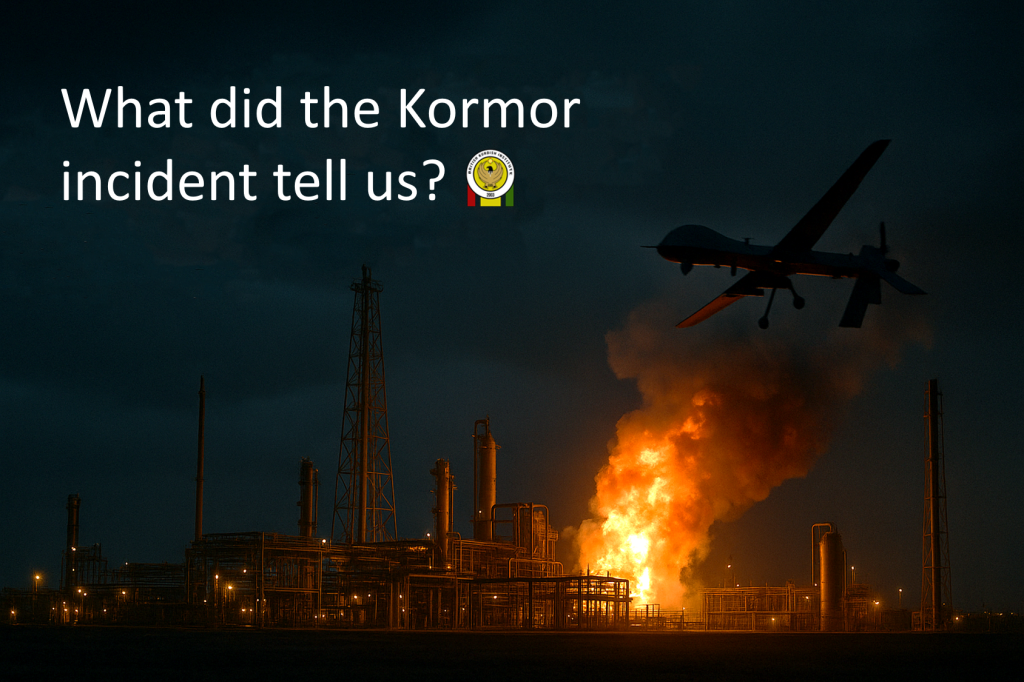

The recent Kormor gas field attacks have exposed a harsh reality about the Kurdistan Region’s long-held assumptions regarding international energy companies, regional politics, and security guarantees. While many believed that the presence of global energy giants would naturally shield Kurdistan from threats, the repeated drone and missile strikes have proven otherwise.
The Myth of Security Through Foreign Energy Companies
After Saddam Hussein’s fall, Kurdistan welcomed major international energy companies, many of which are linked—directly or indirectly—to powerful global states. The expectation was simple:
If Kurdistan hosted these companies, their home countries would protect the region’s stability and security.
But the persistent attacks on oil and gas installations, especially the July drone strikes and the repeated bombardments of the Kormor gas field in Chamchamal, have shattered this belief. These companies have not only failed to protect Kurdistan—they have been unable to safeguard their own assets.
Despite billions in investments and strategic interests, the only response from these states has been routine statements of condemnation. As Ahmad Mukhtar famously said, “Words don’t fill pockets.” And words certainly don’t stop missiles.
Kurdistan’s Failed Strategy for International Support
Kurdistan’s strategy to gain security through the presence of foreign companies has fallen short. These companies have neither deterred attacks nor invested sufficiently in their own protection. Meanwhile, the Kurdistan Region itself lacks the military capacity and advanced defense systems needed to counter drone and missile threats.
Expecting Baghdad to step in is equally unrealistic. Official statements may suggest cooperation, but in practice, Iraq has shown no willingness to protect these sites—and in many cases, the attacking groups are tied to Iraqi state structures.
The “Groups Outside the State” Narrative Is a False Cover
One of the most striking contradictions is the repeated description of the attackers as “groups outside the state.”
In today’s Iraq, such groups do not exist.
ISIS has been dismantled. Armed factions that operate freely in Iraq do so because they are part of, or tolerated by, the state. It is not credible to claim otherwise—especially as the Kormor field has been hit eleven times without accountability.
The truth is clearer:
The attackers are not outside the Iraqi state. The energy fields are outside Baghdad’s control.
Kormor Is Now Essential to Daily Life in Kurdistan
The Kormor gas field is the primary source of electricity for millions of people in the Kurdistan Region. Any disruption directly impacts daily life, public services, and economic stability. This makes the recurring attacks not only a security issue, but a humanitarian and economic one as well.
Because the threats involve long-range drones and precision missiles, defending these sites requires advanced technology—far beyond what the Kurdistan Region currently possesses.
A New Path: Professional U.S. Security Solutions
Since local resources and Iraqi support have proved insufficient—and companies cannot protect themselves—the Kurdistan Region must adopt a new approach.
The combined costs of protecting these energy assets, plus the financial losses from each attack, are already high enough to justify a better solution:
contracting top-tier U.S. security firms.
These companies can provide:
-
advanced radar systems
-
anti-drone and anti-missile defenses
-
real-time monitoring of threats
-
strategic deterrence capabilities
-
pressure mechanisms to prevent Iraqi or Iranian interference
Such a partnership could finally secure Kurdistan’s most critical energy resources and prevent future blackouts or economic damage.