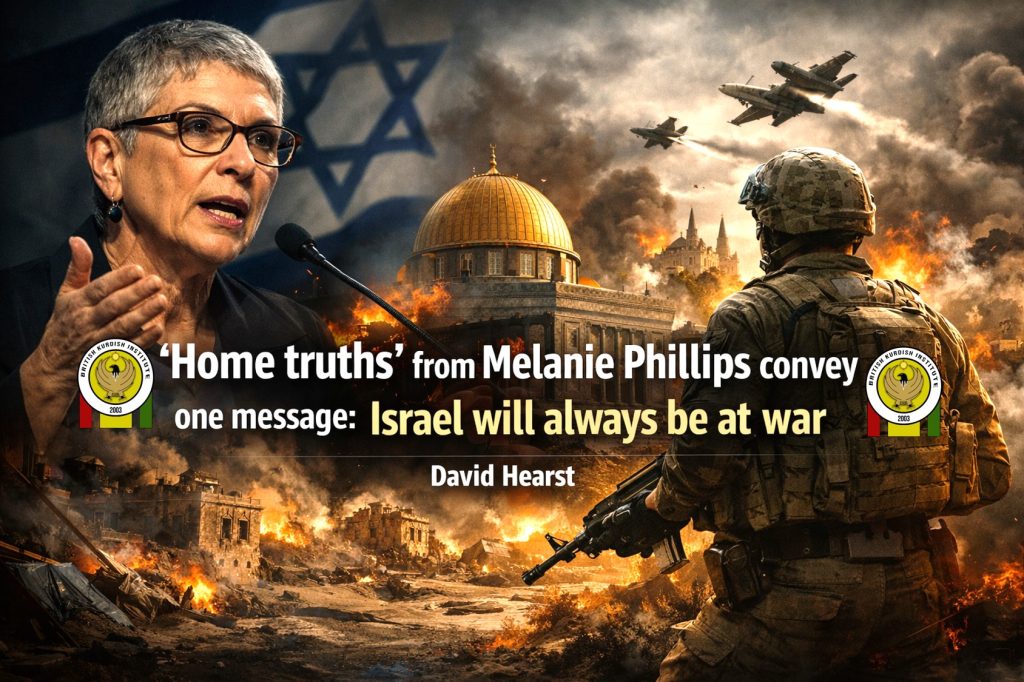

Melanie Phillips’ recent speech in New York stripped away any remaining ambiguity surrounding her political worldview. Delivered at a conference ironically titled “Rage Against the Hate,” her remarks exposed a deeply ideological vision—one that frames Israel’s future as inseparable from endless war.
Once regarded as a liberal voice within British journalism, Phillips’ transformation has been dramatic. Formerly a figure associated with the Guardian’s North London liberalism, she now positions herself at the forefront of a hardline, civilisational narrative that sees Israel under existential threat from Islam itself.
From Liberal Zionism to Ideological Absolutism
Phillips’ journey mirrors that of several former liberal commentators who migrated toward the political right. Yet her evolution appears driven less by career incentives and more by a growing conviction that Israel’s survival requires ideological clarity rather than compromise.
At the Guardian, Zionism was framed as compatible with liberal values. Today, Phillips rejects that tradition entirely. In her worldview, Israel’s legitimacy is exclusive, absolute, and divinely sanctioned—leaving no room for Palestinian nationhood.
Denying Palestine, Redefining the Conflict
In language reminiscent of authoritarian nationalism, Phillips asserted that Palestine and Palestinians do not exist as legitimate entities. According to her, Jews are the sole indigenous people with historical, moral, and legal rights to the land “from the river to the sea.”
This framing deliberately recasts a territorial conflict as a religious one. By doing so, it escalates the stakes dramatically—positioning Israel not against specific political movements, but against nearly two billion Muslims worldwide.
A Civilisational War Narrative
Phillips extended her argument beyond geography. Christianity, she claimed, is merely a Jewish sect that “got out of hand,” while Islam was labelled a “death cult.” Western values, she argued, are fundamentally Jewish—and the West itself is courting destruction by sympathising with Palestinians.
This rhetoric does more than inflame tensions; it redefines the Israel-Palestine conflict as an unavoidable clash of civilisations, one that cannot be resolved through diplomacy or coexistence.
The Diaspora as an Ideological Battlefield
Perhaps the most destabilising aspect of Phillips’ speech was her attack on Jewish communities outside Israel. She insisted that diaspora Jews owe their primary loyalty to Israel, not to the countries in which they live.
Those who express discomfort with Israel’s actions, she argued, are weak, appeasing, and excessively concerned with global opinion. This rejection of pluralism risks alienating precisely the communities Israel relies on most for political and moral support.
Biblical War and the Glorification of Violence
Phillips went further still, celebrating what she described as the “resurrection of the Tanakh Jew”—a return to biblical warfare and conquest. The war in Gaza, she suggested, is not merely self-defence but the fulfilment of ancient prophecy.
In this telling, modern international law and civilian suffering are secondary to a divine historical mission—an interpretation that leaves no space for peace, restraint, or accountability.
Permanent War as Policy
The implications of this ideology are clear. If Israel’s destiny is perpetual expansion and religious war, ceasefires become tactical pauses rather than steps toward peace.
From Gaza to Lebanon to Syria, Israeli military actions increasingly reflect this logic. Ceasefires hold only as long as opponents refrain from retaliation, while territorial expansion and targeted assassinations continue unabated.
Regional Spillover and the Risk of Wider War
Israel’s actions in southern Syria, including the seizure of territory and establishment of military bases, have heightened regional instability. Iranian officials have made clear that future conflicts will not remain contained—and that neighbouring states hosting Israeli or Western assets may be drawn in.
None of Israel’s regional adversaries consider themselves defeated. Groups like Hamas and Hezbollah view recent losses as tactical, not strategic, and are already rearming.
The Illusion of International Solutions
Meanwhile, proposed international stabilisation forces for Gaza remain largely theoretical. No clear mandate, funding, or personnel commitments exist. Arab and Muslim states are unwilling to participate without a genuine path to Palestinian statehood.
As a result, UN resolutions risk becoming symbolic gestures rather than viable frameworks for peace.
One Unavoidable Conclusion
Phillips’ so-called “home truths” ultimately deliver a single, stark message: Israel is preparing for a future of permanent war. This reality is neither new nor surprising to Palestinians and neighbouring states, who have lived with its consequences for decades.
What is new is the openness with which this vision is now articulated—and the degree to which it is tolerated within Western media and political discourse.