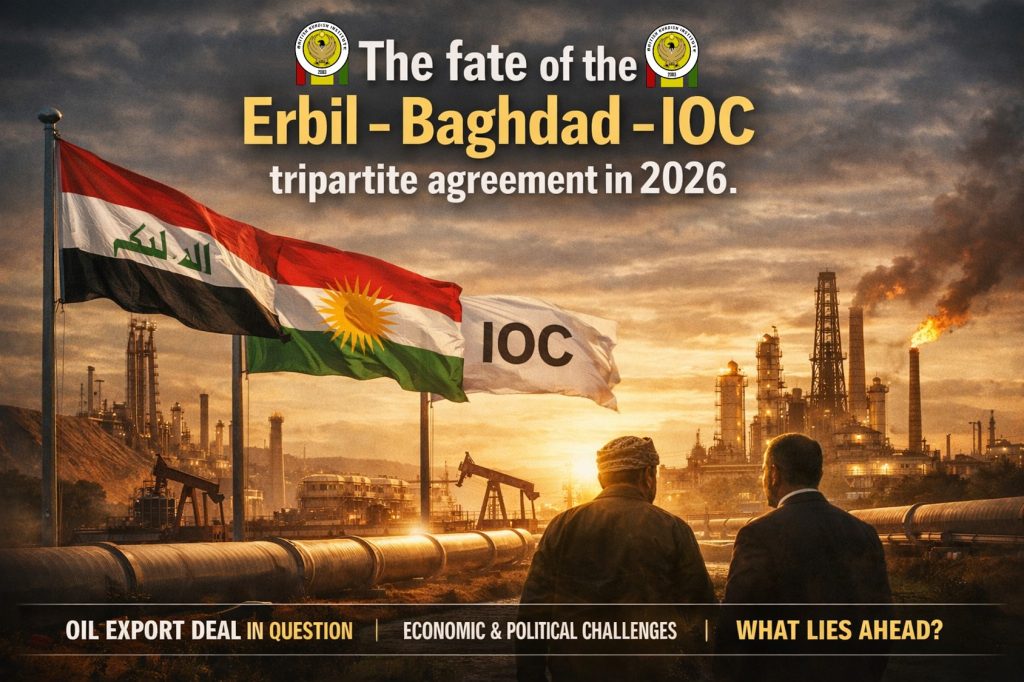

More than three months ago, a tripartite agreement was signed between the Kurdistan Regional Government (KRG), the Iraqi federal government, and international oil companies (IOCs to resume the export of crude oil from Kurdistan Region fields through federal pipelines to global markets.
According to the penultimate clause of the agreement, it entered into force for an initial period of 30 days and was automatically extended until December 31, 2025. The agreement also allows the parties to extend its duration or terminate it earlier by mutual consent. As 2026 approaches, questions are mounting over whether the deal will survive—and under what conditions.
SOMO’s Position and Control Over Kurdistan Oil
On December 21, Iraq’s State Oil Marketing Organization (SOMO) issued a clarification following a Reuters report on oil sales from the Tawke field operated by DNO. SOMO stressed that all oil companies operating in the Kurdistan Region are committed to delivering produced crude to the federal government for export or domestic use.
SOMO further emphasized that international oil companies must hand over all produced oil—except volumes allocated for domestic consumption—to the federal marketer. This statement reaffirmed Baghdad’s intent to consolidate control over exports originating from the Kurdistan Region.
Consulting Firms, Cost Reviews, and Delayed Implementation
Under the agreement, an international consulting firm is tasked with reviewing production costs, operational expenses, investment returns, and company profits. While Wood Mackenzie was initially mentioned as a leading candidate, it has yet to begin work.
According to available information, the consulting firm—whether Wood Mackenzie or another entity—is expected to start its assessment in early 2026, a delay that continues to fuel uncertainty among oil companies and policymakers alike.
Kirkuk Oil, Pricing Mechanisms, and Export Discrepancies
The agreement classifies Kirkuk oil as part of Kurdistan Region exports. SOMO markets this crude at Brent-linked prices for Europe, Oman-linked prices for Asia, and WTI benchmarks for the United States.
However, despite these provisions, SOMO did not list Kirkuk crude among its official export streams for January 2026. This omission has raised questions about transparency, pricing mechanisms, and the future classification of northern Iraqi oil exports.
The Central Question for 2026
As the agreement nears its expiration, a critical question emerges: What will be the fate of the Erbil–Baghdad–IOC tripartite oil agreement in 2026? And more importantly, why does its continuation—despite its flaws—remain strategically necessary?
Key Challenges Facing the Agreement in 2026
Revenue Distribution and Fiscal Imbalance
Current export patterns resemble the pre-agreement phase, with SOMO exporting significant volumes while the Kurdistan Region receives limited financial returns. According to SOMO’s November report, exports of Kirkuk oil via Ceyhan reached over 252,000 barrels per day, following 188,000 bpd in October—amounting to more than 20 million barrels in recent months.
Yet, the Kurdistan Region’s share has been largely restricted to employee salaries, without sufficient funds for operational spending, investment, or development. This fiscal imbalance remains one of the agreement’s most contentious issues.
Political Transition and Uncertain Erbil–Baghdad Relations
As Iraq undergoes institutional restructuring and political negotiations, the future of Erbil–Baghdad relations remains unclear. Will Kurdistan’s entitlements be limited to salary payments? Will future budget laws replicate the semi-legal frameworks currently in place? Or can Iraq move beyond politicizing economic disputes toward a stable, rights-based financial relationship similar to the post-2005 period?
Accumulated Debts to International Oil Companies
One of the most serious obstacles is the nearly $1 billion in accumulated debts owed to international oil companies for production between September 2022 and March 2023—most of it owed to Norway’s DNO.
Although the agreement promised a debt repayment mechanism within one month of signing, implementation has stalled. DNO has continued limited participation while making debt repayment a core condition for its ongoing involvement.
Oil-Based Repayment Mechanisms
Currently, SOMO compensates companies through oil allocations rather than cash, using a formula based on barrels delivered at Ceyhan multiplied by a fixed price factor. While this method covers past domestic sales and outstanding entitlements, it raises concerns about sustainability, profitability, and long-term investor confidence.
Will this oil-based repayment model continue in 2026, or will a new mechanism be introduced?
Oil Quality and API Discrepancies
Another critical challenge lies in oil quality. The agreement assumes an API gravity of 36 degrees, yet most Kurdistan Region fields fall well below this benchmark.
Current production includes Tawke crude at 28 API, Sheikhan at 18 API, Atrush at 24 API, and only Sarsang exceeding Kirkuk quality at 37–39 API. Although SOMO has adjusted Kirkuk’s quality specifications for January 2026, the gap between contractual assumptions and reality remains significant.
The Iraq–Turkey Pipeline Agreement and Regional Stakes
In July 2026, the Ankara–Baghdad agreement governing exports via the Iraq–Turkey Pipeline (ITP) expires. Turkey has already presented new demands related to capacity utilization and export volumes, seeking to avoid a repeat of the prolonged pipeline shutdown.
These negotiations are further complicated by BP’s $25 billion investment in Kirkuk oil and gas fields, aimed at boosting production to nearly 500,000 bpd.
Notably, Kurdistan Region representatives—and even officials from SOMO—have been excluded from recent talks, despite the Region’s critical role in future oil and gas transit.
Conclusion: Why Continuation Still Matters
Recent developments indicate that tanker transport contracts to the Ceyhan pipeline have been extended until April 2026, signaling short-term continuity. No party has formally opposed extending the agreement, and SOMO has reiterated its commitment to ongoing exports.
While unresolved issues—company debts, oil quality, and pipeline negotiations—may not halt exports outright, they are likely to reshape the agreement’s structure in 2026.
Ultimately, resuming pipeline exports, even under the current framework, carries tangible benefits. For the Kurdistan Region, it enables renewed investment, CAPEX recovery, and production growth. For Iraq, it reinforces export sovereignty and compliance with OPEC quotas.
The real test, however, remains Baghdad’s ability to establish a sustainable and equitable financial relationship with Erbil—an issue far more complex than technical or contractual disputes.