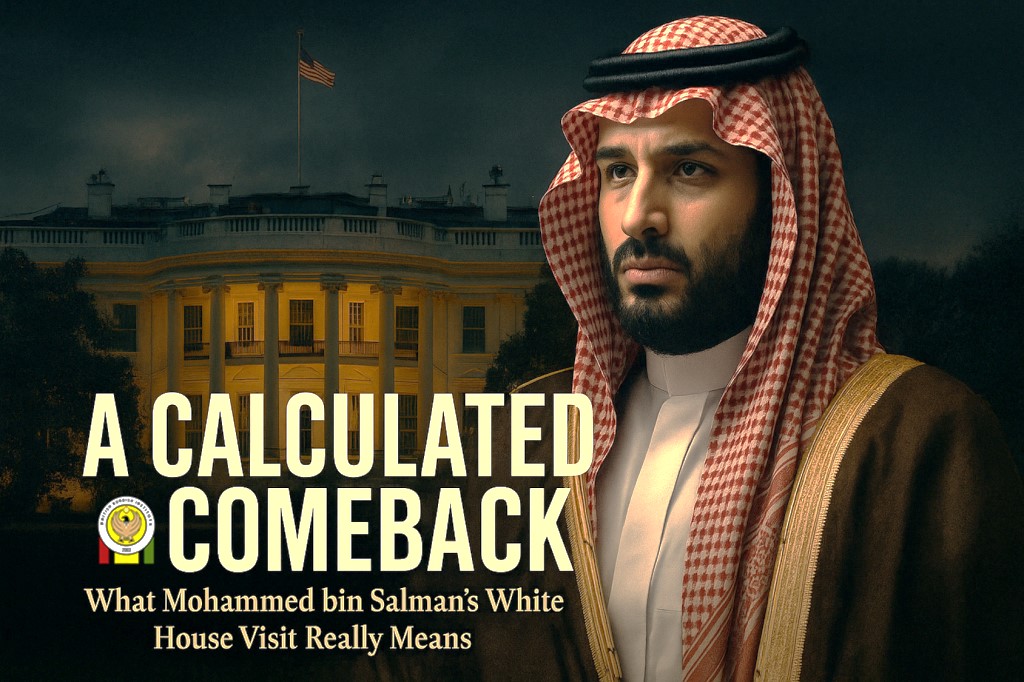

Saudi Crown Prince Mohammed bin Salman’s (MBS) return to the White House is far more than a diplomatic courtesy—it represents a strategic re-entry into global politics, a recalibration of U.S.–Saudi ties, and a carefully crafted move to elevate his international influence. Behind the ceremonial meetings lies a multilayered agenda intertwining security, economics, regional diplomacy, and MBS’s long-term quest for legacy.
A Strategic Push for a New Security Order
At the center of the visit is an ambitious security agenda. MBS is reportedly pressing Washington for deeper military cooperation, including advanced weapons systems, stronger intelligence-sharing mechanisms, and potentially even a formal U.S. security guarantee.
Some analysts suggest the talks could mirror the U.S.–Qatar defense pact—an agreement that, if replicated, could dramatically shift the Gulf’s security architecture.
A U.S. commitment to defend Saudi Arabia from external threats would not only reinforce Riyadh’s sense of security but also reshape the balance of power across the region.
Economic Ambitions Driving the Visit
Beyond defense, the economic stakes of this trip are enormous. MBS is reportedly increasing Saudi Arabia’s investment pledge in the United States from $600 billion to nearly $1 trillion. These investments target critical and future-driven sectors:
-
artificial intelligence
-
semiconductors
-
rare earth materials
-
high-tech manufacturing
-
potential civilian nuclear cooperation
This is not generosity—it is strategic.
Saudi Arabia urgently needs post-oil diversification, while the U.S. seeks capital and long-term technological partners. Through massive investments, MBS aims to accelerate Vision 2030, shape the global technology race, and secure lasting leverage in Washington.
Repositioning Saudi Arabia as a Regional Powerbroker
The visit extends beyond bilateral relations. MBS is signaling that Saudi Arabia intends to play a more assertive role in regional diplomacy. Reports indicate that Riyadh is prepared to:
-
engage more constructively on Gaza
-
maintain controlled diplomatic channels with Iran
-
revisit normalization prospects with Israel
However, the crown prince remains firm:
no Saudi–Israel normalization without tangible progress toward a Palestinian state.
This stance allows Riyadh to balance its reformist image with longstanding political commitments, positioning itself as both modern and principled.
Lingering Tensions and the Cost of Partnership
Despite the triumphant tone, the visit does not escape controversy. Washington still harbors concerns over human rights and political freedoms in Saudi Arabia. Yet these issues appear increasingly overshadowed by strategic and economic imperatives. Both sides are prioritizing stability, investment, and shared interests over ideological disagreements.
For the U.S., embracing MBS is a calculated risk—one that may yield geopolitical gains but also provoke domestic criticism and deeper involvement in Saudi Arabia’s ambitions.
A potential defense pact raises difficult questions:
Would the U.S. respond militarily if Saudi Arabia were attacked?
What commitments would Washington demand in return?
And how would this reshape American relations with Iran, Israel, and other Gulf states?
A High-Stakes Legacy Gamble for MBS
Ultimately, the visit is about legacy.
MBS is betting on a future defined by technological transformation, regional leadership, and global rebranding. Yet the risks are significant: economic volatility, diplomatic backlash, or regional miscalculation could threaten the narrative he is trying to build.
Still, the symbolism of his White House return is undeniable. It signals a leader more confident, more assertive, and determined to shape the geopolitical landscape on his own terms.
The Road Ahead
For Washington, the visit reinforces a familiar truth:
strategic influence, investment flows, and regional stability continue to outweigh points of friction.
For Saudi Arabia, the moment is both victorious and precarious—a high-stakes geopolitical bet whose real consequences will unfold over time.