
A Federal System on Paper, a Central Reality in Practice
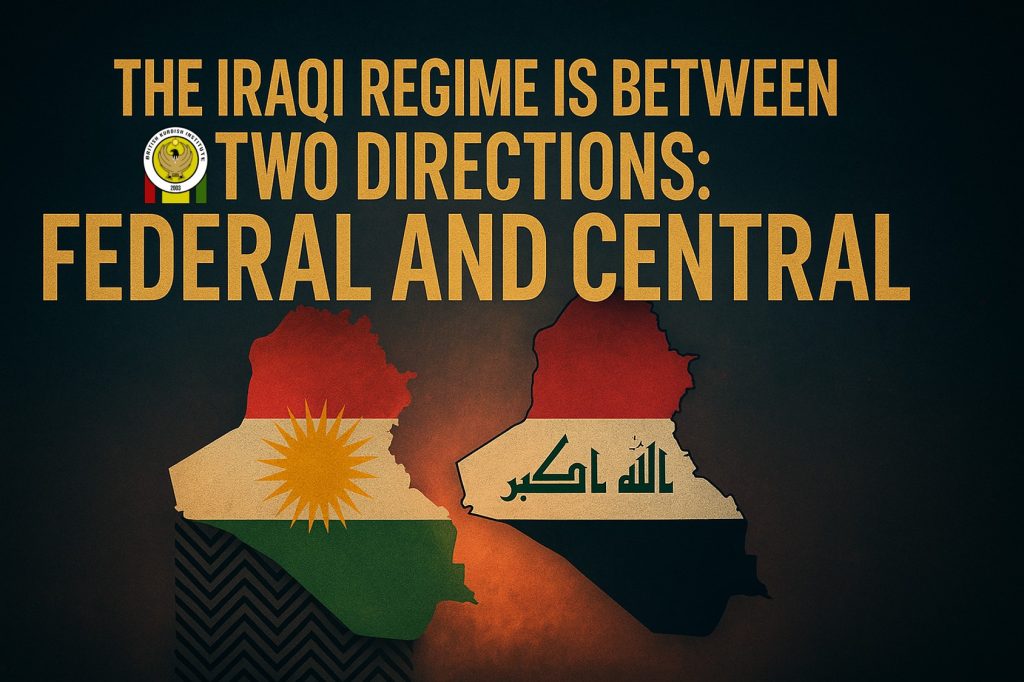
Iraq’s post-2003 constitution officially defines the country as a federal state, designed to distribute power between Baghdad and the regions.
Yet, in practice, centralized authority continues to dominate Iraq’s political, legal, and administrative institutions.
While federalism exists in writing, its implementation has been blocked by political agendas, judicial interpretations, and the legacy of centralized power inherited from the Ba’ath regime.
This tension between law and reality remains one of the greatest challenges facing Iraq’s democracy.
From Saddam’s Centralism to a Promised Federal Iraq
Before 2003, Iraq was governed by an authoritarian regime centered entirely around Saddam Hussein’s personal power.
All laws—especially those with political or national impact—reflected his will rather than public consensus.
Following the fall of the Ba’ath regime, Iraqis sought to rebuild the nation through a federal system that promised equality, balance, and decentralization.
The 2005 Constitution was meant to enshrine these principles and ensure no single leader could dominate the state again.
Two decades later, however, Iraq still struggles between the idea of federalism and the persistence of centralized rule.
The Federal Court and the Return of Central Authority
The Federal Supreme Court was established to guide Iraq’s transition from dictatorship to federal democracy.
But in recent years, many of its rulings have revived the centralist spirit of the past—especially in cases concerning the Kurdistan Region.
By relying on laws that predate the 2005 Constitution, the court has effectively reimposed Baghdad’s authority on regional matters, particularly disputes over oil and gas management.
This stands in direct contradiction to Article 112 of the Constitution, which requires that the KRG and the federal government jointly manage natural resources.
The Kurdistan Regional Government was therefore correct in declaring such rulings unconstitutional, as they undermine the essence of Iraq’s federal framework.
Judicial Overreach and Unchecked Power
The Federal Court wields near-absolute power to interpret the constitution.
This unchecked authority allows it to alter the meaning of constitutional provisions, sometimes bypassing the formal amendment process that would normally involve parliament and public approval.
As a result, Iraq’s judiciary has gradually centralized political power, reversing the intended decentralization of the federal system.
This silent form of legal manipulation has become a subtle but effective return to centralized governance.
Political Resistance to Federalism
Many Shiite political factions, now dominant in Baghdad, have expressed long-standing regret over Iraq’s federal system.
They have blocked proposals to establish new regions in the south, marginalized Sunni provinces, and often refer to the Kurdistan Region dismissively as “three northern provinces.”
This language reflects a political effort to redefine federalism as a form of central control rather than shared governance.
By doing so, Baghdad maintains power over Iraq’s regional diversity under a veil of constitutional legitimacy.
Two Bodies, One Direction: Judiciary and Politics
In recent years, the Federal Court’s decisions and the ruling Shiite parties’ agendas have converged.
Together, they form a dual mechanism of centralization, leading Iraq toward a system where federalism exists in name only.
This alignment has transformed Iraq into a hybrid regime—one that maintains the appearance of federal structure but operates under centralized political dominance.
Why Federal Laws Still Matter
Beyond political agendas or judicial interference, Iraq’s incomplete federal transition stems largely from the failure to pass essential federal laws.
For Iraq to fully embody federalism and move beyond its authoritarian past, parliament must enact long-delayed legislation, including:
-
The Oil and Gas Law
-
The Federal Council Law
-
Regulations on resource sharing and regional authority
These laws are not symbolic; they represent the core foundation of true federal governance.
The Kurdistan Region’s Missed Leverage
While Baghdad bears responsibility for centralization, Kurdish political actors have also failed to use their influence effectively.
The Kurdistan Region’s representatives in Baghdad have not applied consistent pressure to ensure the implementation of federal provisions or the protection of constitutional rights.
This lack of strategic engagement has weakened Erbil’s negotiating power and allowed centralization to advance unchecked, resulting in recurring crises between the two sides.
A Call for Federal Renewal
To prevent Iraq from slipping back into autocracy or one-party control, the government must enforce these federal laws—not as tools of negotiation, but as constitutional rights.
After decades of struggle, Iraq’s people—especially the Kurds—deserve a system of genuine balance, equality, and pluralism.
Federalism was meant to replace the Ba’athist legacy, not become another promise buried under political compromise.