
A Constitutional Promise Unfulfilled
When Iraq’s permanent constitution was drafted, it was hailed as a milestone for Kurdish rights — a framework intended to guarantee equality, autonomy, and representation.
Yet, two decades later, that promise remains largely unfulfilled.
Since its inception, the Iraqi state has rarely adhered fully to the constitutional framework, applying it selectively to serve the interests of those in power.
Because Iraq’s political system is built on deep ethnic, religious, and ideological divides, every group that gains authority has often used the constitution not as a national pact, but as a political weapon.
Without strong constitutional institutions to uphold or investigate violations, the rule of law has often been reduced to rhetoric — and the constitution’s existence, at many stages, has seemed symbolic rather than binding.
Post-Saddam Iraq: Missed Opportunities for Kurdish Power
After Saddam Hussein’s fall, Iraq’s reconstruction offered an unprecedented opportunity for inclusion.
All major communities shared power, and the constitution formally recognized Kurdish rights within a federal framework.
Yet, over the past two decades, the Kurdish leadership has failed to fully defend or implement these provisions.
Two key reasons stand out:
-
Kurdish demands were constitutionalized during a time of conflict, achieved through struggle and sacrifice — but never fully secured in practice.
-
Kurdish political forces, despite holding significant positions in Baghdad, did not leverage their influence to enforce the constitution or safeguard federal guarantees.
This neglect has weakened the Kurdish position both within Baghdad’s corridors of power and across the Kurdistan Region itself.
Baghdad’s Expanding Dominance
As political power in Baghdad consolidated under sectarian and regional influences, the central government expanded its dominance beyond the constitutional boundaries.
This hegemony has extended to Sunni regions like Mosul, Diyala, and Anbar, and even into Kurdish-populated areas outside the Kurdistan Region.
The strategy reflects a broader agenda — to reshape Iraq’s political geography under sectarian priorities, often at the expense of pluralism and federalism.
The Kurdish Path Back to Baghdad
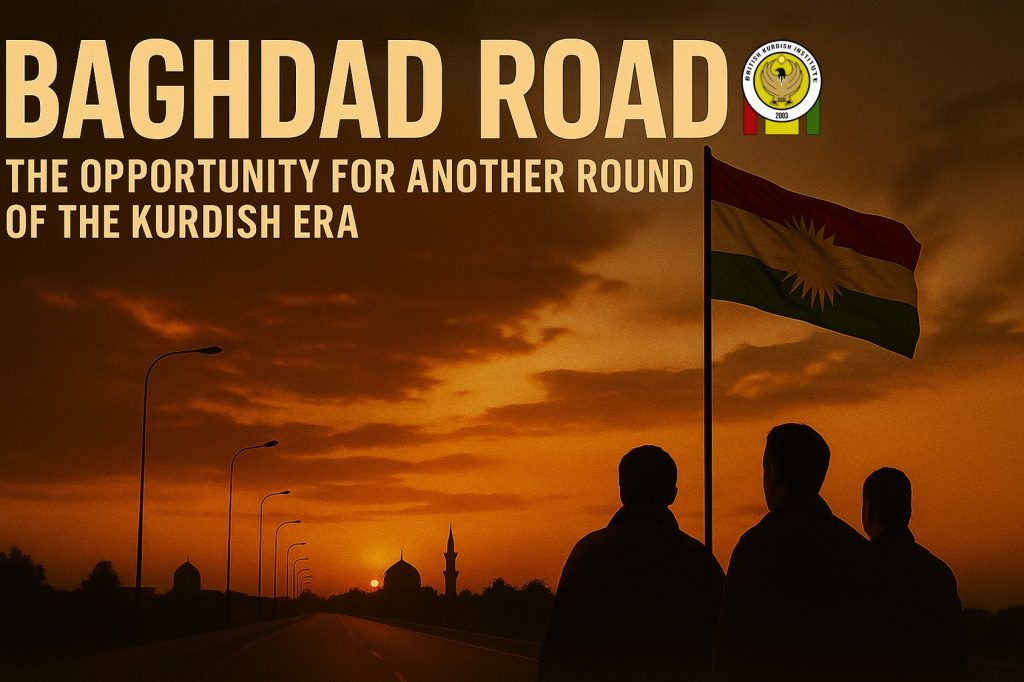
To safeguard their identity, dignity, and constitutional rights, the Kurds must return to Baghdad — politically, not militarily.
The struggle for Kurdish rights cannot be fought solely from Erbil; it must be re-anchored in Iraq’s national institutions.
Despite marginalization, Kurds still hold key positions in the Iraqi government.
Now, with new regional tensions — particularly following the Hamas–Israel war — and growing U.S. pressure on Baghdad, the political landscape is shifting.
These dynamics create a rare opening for Kurds to reassert their constitutional role.
Why This Moment Matters
Baghdad’s past efforts to erode Kurdish autonomy — from economic blockades to missile and drone attacks — failed to dismantle the Kurdistan Region.
But that does not mean the ambitions have disappeared.
Shiite leaders continue to describe Iraq’s current constitution as a “Kurdish-American imposition” and have expressed intent to revise it whenever an opportunity arises.
That is precisely why this moment demands Kurdish unity and strategic engagement.
If Kurdish leaders can act collectively in Baghdad, they can use their existing leverage to enforce constitutional guarantees, resist unilateral amendments, and restore balance in Iraq’s power structure.
Elections and the Return of Kurdish Influence
With parliamentary elections approaching, Kurdish participation in Baghdad’s political process is critical.
Even though internal divisions have prevented a unified Kurdish coalition, post-election alliances could offer a second chance.
A renewed Kurdish bloc — committed to protecting constitutional rights — could reclaim influence, ensuring that Baghdad once again views Kurdistan as a partner, not a province.
The Need for Unity and Courage
Kurdistan has endured crises that threatened to erase its hard-won gains.
Yet today, it stands at a crossroads — between constitutional empowerment and political decline.
The lessons of past decades are clear: division weakens, but unity rebuilds.
To secure what is already written in the constitution, the Kurds need determination, loyalty, and visionary leadership.
In moments of uncertainty, history honors those who act boldly for their people.
The new Kurdish era will not be granted — it must be earned through unity, diplomacy, and a return to Baghdad’s political battlefield.